
Candela Laser Troubleshooting: Common Problems Clinics Can Check First
Candela laser troubleshooting often starts with simple checks. When a Candela laser stops in the middle of a busy clinic day, every hour of downtime costs patients and revenue. Many faults need a trained engineer, but some have simple causes that your own staff can check in a few minutes, such as a low water level, a dirty handpiece window or an unstable power supply.
I’m Sohail Sarwar, an electrical engineer and CEO of Dermionic Technologies. We have supplied, installed and serviced aesthetic lasers in Pakistan since 2006. This guide covers the most common Candela laser problems we see in clinics, what your team can safely check first, and when it is time to stop and call a technician.
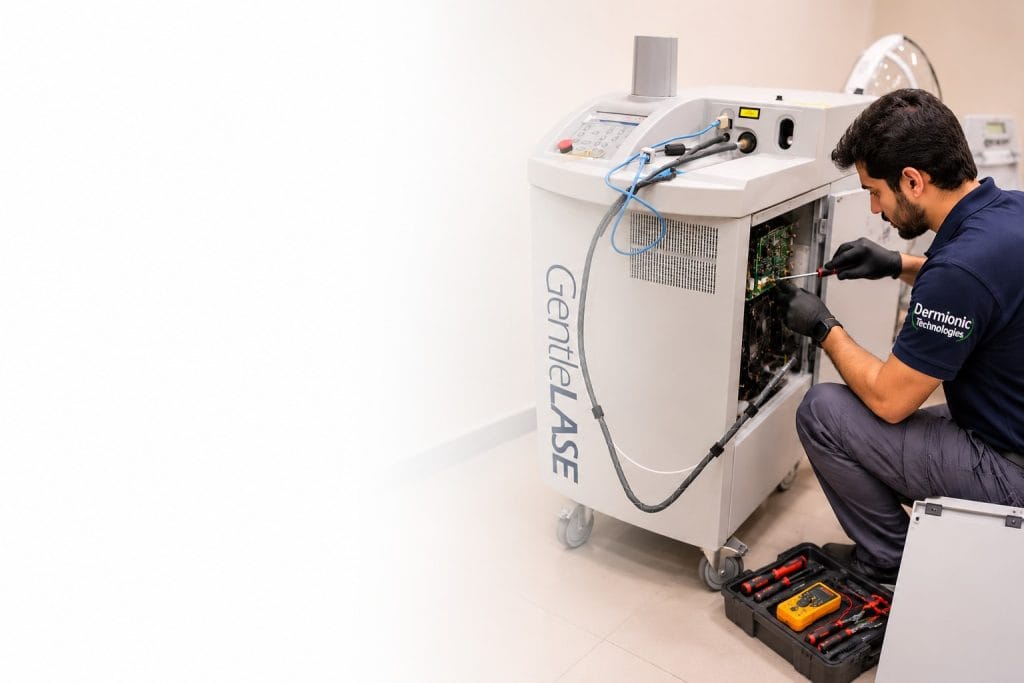
Safety First: What Clinic Staff Should Never Do
Candela lasers are Class 4 medical lasers with high-voltage power supplies. Even after the machine is switched off, internal capacitors can hold a dangerous charge. Before you check anything, follow these rules:
- Never remove the machine’s covers or panels. Internal work is for trained engineers only.
- Never fire the laser for testing without the correct protective eyewear for the wavelength (755nm or 1064nm).
- Never bypass an alarm, interlock or safety switch to keep treating patients.
- If you smell burning, see smoke or find water leaking inside the machine, switch it off at the mains and do not restart it.
Know Which Candela System You Have
The Candela laser troubleshooting checks below apply to most Candela Medical hair removal platforms, but it helps to know your model when you describe a fault to a technician:
- GentleLase: 755nm alexandrite laser, mainly for hair removal and pigmented lesions.
- GentleYAG: 1064nm Nd:YAG laser, suited to darker skin types and vascular work.
- GentleMax Pro: combines 755nm and 1064nm in one system.
If you are still deciding between models, see our comparison of GentleLase vs GentleMax Pro.
Candela Laser Troubleshooting: Common Problems and What to Check First
1. The laser will not go to “Ready” or will not fire
This is the most common of all Candela laser problems. Before assuming a major fault, check the simple things:
- Is the emergency stop button released?
- Is the key switch fully turned and the door or remote interlock connected?
- Is the footswitch or handpiece trigger cable firmly plugged in?
- Has the machine finished its warm-up? Candela systems need time to bring the water to operating temperature after start-up.
- Is there a water, temperature or cryogen message on the screen? The laser will usually refuse to fire until that alarm is cleared.
If all of these are fine and the laser still will not fire, the cause is usually inside the machine, for example the high-voltage supply, the flashlamp or the control electronics.
2. Weaker results or inconsistent energy
If doctors notice that treatments feel weaker, or patients are not getting the usual results at the same settings, the laser may be delivering less energy than the screen shows. Common causes are:
- A dirty or scratched handpiece window or lens.
- An ageing flashlamp. Flashlamps have a limited life measured in shots and gradually lose output.
- A damaged or tightly bent delivery fiber.
- Optics inside the laser head that need cleaning or alignment.
Your staff can clean the handpiece window as the operator manual describes. Flashlamps, fibers and internal optics should be checked by a technician with a calibrated energy meter.
3. Calibration fails
Candela systems check their own output during calibration. A failed calibration is the machine telling you that it cannot reach the expected energy. Clean the handpiece and calibration port, check that the handpiece is seated properly, and try once more. If it fails again, do not keep repeating it. Repeated failures usually point to the flashlamp, fiber or laser head and need a proper diagnosis.
4. Water level, flow or temperature alarms
The laser head is cooled by a closed water circuit. Water faults are among the most common Candela laser problems in Pakistan, especially in summer. Check:
- The water level, if your model has a visible reservoir or level indicator.
- That only distilled or deionized water has been used. Tap water or mineral water leaves deposits and damages the cooling system.
- Whether the deionizer filter and particle filter are due for replacement.
- Whether there are any water drops under or around the machine.
Topping up with the wrong water, or running the laser with a flow alarm, can damage the laser head and lead to a much more expensive repair.
5. The machine overheats or stops during long sessions
Candela lasers move heat out of the machine through fans and a heat exchanger. In a hot room this cannot work properly. Make sure:
- The treatment room is air-conditioned, ideally below about 25°C.
- The air vents are not blocked by walls, curtains or trolleys.
- The air filters are free of dust. Dust builds up quickly in Pakistani cities and should be checked regularly.
6. Cooling spray (DCD) problems
GentleLase and GentleMax Pro use the Dynamic Cooling Device (DCD), which sprays a short burst of cryogen onto the skin just before each pulse. This protects the skin from burns, so a DCD problem must never be ignored. Signs include no spray, a weak or uneven spray, a cryogen warning on the screen, or patients suddenly feeling more heat.
Check that the cryogen canister is not empty, that it is installed correctly and that the spray nozzle on the handpiece is clean. If the spray is still weak, stop treating patients until it has been inspected.
7. Handpiece and distance gauge issues
The handpiece is the part that is handled most, so it takes the most wear. Look for cracks, a loose or bent distance gauge, gel or debris on the window, and damage to the cable where it joins the handpiece. Store the handpiece in its holder between patients and never let the fiber hang or kink.
8. The machine switches off or restarts by itself
In Pakistan, power is often the hidden cause of Candela laser problems. Load shedding, voltage drops and spikes when the generator changes over can trip the laser or damage its power supply over time. Check:
- That the laser is on a dedicated circuit with the correct rating, not shared with air conditioners.
- That you are using a good-quality voltage stabilizer, and an online UPS where possible.
- That the machine is switched off before the generator changes over, if you do not have a UPS.
- That the wall socket and plug are not loose or heat-marked.
9. An error message appears on the screen
Do not keep restarting the machine to clear an error. Instead:
- Take a clear photo of the exact message or code.
- Write down what was happening when it appeared, such as start-up, calibration or mid-treatment.
- Note the model, approximate shot count and when it was last serviced.
This information lets a technician narrow down the fault quickly, often before visiting your clinic.
Simple Habits That Prevent Most Candela Laser Problems
- Start the machine and let it warm up fully before the first patient.
- Clean the handpiece window and DCD nozzle as the manual recommends.
- Use only distilled or deionized water in the cooling system.
- Keep the room cool and dust-free, and keep the air vents clear.
- Protect the laser with a stabilizer or UPS.
- Book preventive maintenance at regular intervals instead of waiting for a breakdown.
When to Stop and Call a Technician
Candela laser troubleshooting by clinic staff has limits. Call a qualified engineer if the problem continues after the basic checks above, if the machine shows repeated calibration failures, if there is any water leak, burning smell or unusual noise, or if patients report more heat or pain than usual. Continuing to use a faulty laser often turns a small repair into a major one.
Dermionic Technologies provides Candela laser repair in Pakistan, including diagnosis, cooling-system service, handpiece checks and preventive maintenance for GentleLase, GentleYAG and GentleMax Pro systems. Send us a photo of the error and your machine details on WhatsApp (0317 5505386), and our team will advise on the next step.
Repair or Replace an Older Candela?
If your machine is very old and needs several major parts at once, compare the repair cost with a tested refurbished system. We stock refurbished units such as the Candela GentleLase and Candela GentleMax Pro, and can help you decide which option makes more sense for your clinic.
Frequently Asked Questions
Can I use tap water or mineral water in my Candela laser?
No. Use only distilled or deionized water. Tap water and mineral water contain minerals that leave deposits in the cooling circuit and can damage the laser head.
Why is my Candela laser weaker than before at the same settings?
The most common causes are a dirty handpiece window, an ageing flashlamp, or a damaged fiber. The real output can only be confirmed with a calibrated energy meter during a service visit.
Is it safe to keep treating patients if the cooling spray is weak?
No. The DCD spray protects the skin from burns. If it is weak, uneven or missing, stop treatments until the system has been checked.
How often should a Candela laser be serviced?
It depends on how busy your clinic is, but most clinics benefit from preventive maintenance at regular intervals, plus an immediate check whenever an alarm keeps coming back.
Written by Sohail Sarwar, Electrical Engineer and CEO of Dermionic Technologies, supplying and servicing aesthetic lasers in Pakistan since 2006. Dermionic Technologies is an independent supplier and service provider and is not affiliated with Candela Corporation.

Sohail Sarwar is an Electrical Engineer specializing in Electronics, and CEO at Dermionic Technologies. His engineering background gives him a hands-on, technical understanding of how aesthetic laser systems, diode technology, and RF-based devices actually work under the hood — from power delivery and calibration to long-term reliability. He writes to help clinics in Pakistan make informed, technically sound decisions when investing in aesthetic and medical equipment. Connect with him on LinkedIn.